LELA 🌙: LLM-based Entity-Linking Approach

Entity linking (mapping ambiguous mentions in text to entities in a knowledge base) is a foundational step in tasks such as knowledge graph construction, question-answering, and information extraction. Our method, LELA, is a modular coarse-to-fine approach that leverages the capabilities of large language models (LLMs), and works with different target domains, knowledge bases and LLMs, without any fine-tuning phase. Our experiments across various entity linking settings show that LELA is highly competitive with fine-tuned approaches, and substantially outperforms the non-fine-tuned ones.
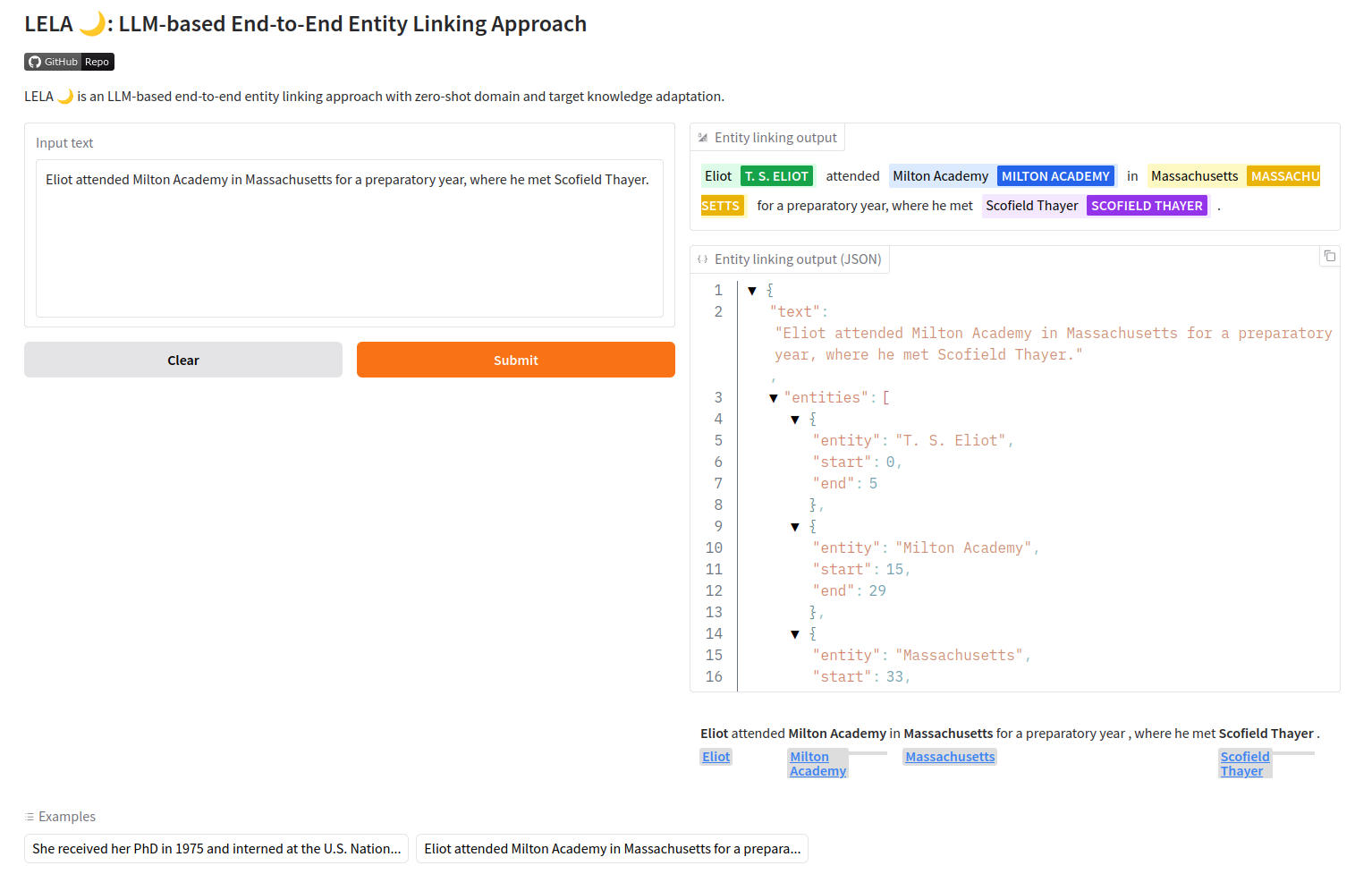
LELA 🌙: LLM-based Entity-Linking Approach
#llm
#entity-linking
#entity-disambiguation
#nlp

Retrieval-Constrained Decoding Reveals Underestimated Parametric Knowledge in Language Models

Language models (LMs) encode substantial factual knowledge, but often produce answers judged as incorrect. We hypothesize that many of these answers are actually correct, but are expressed in alternative surface forms that are dismissed due to an overly strict evaluation, leading to an underestimation of models' parametric knowledge. We propose Retrieval-Constrained Decoding (RCD), a decoding strategy that restricts model outputs to unique surface forms. We introduce YAGO-QA, a dataset of 19,137 general knowledge questions. Evaluating open-source LMs from 135M to 70B parameters, we show that standard decoding undervalues their knowledge.

#llm
#constrained-decoding
#nlp
#konwledge-graphs

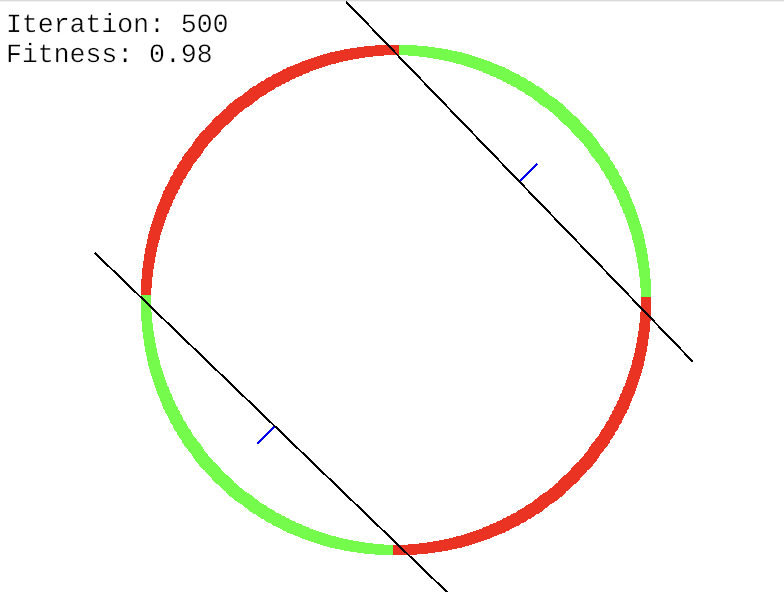
Implementation and Evaluation of Recent Neuroevolution Algorithms

Master's thesis, supervised by Prof. Carsten Witt, at the Technical University of Denmark.

Implementation and Evaluation of Recent Neuroevolution Algorithms
#Neuroevolution
#EA
#ES
#Rust